Skip to content
{} zero dependency

// answer sheet

Standard-library cheat-sheets

What your language does without a package, where it stops, and which import is worth replacing by hand.

verified Node 24.19 LTS / 26.x · Python 3.14.7 · Go 1.27 · Rust 1.98 · Java 25 LTS · .NET 10 LTS · Bun 1.4 — 27 August 2026

// ask the machine first

Stuck? Give your AI the whole event.

Rules, tracks, scoring and every cheat-sheet on this page, as plain text. It answers from this event instead of guessing.

~40 KB
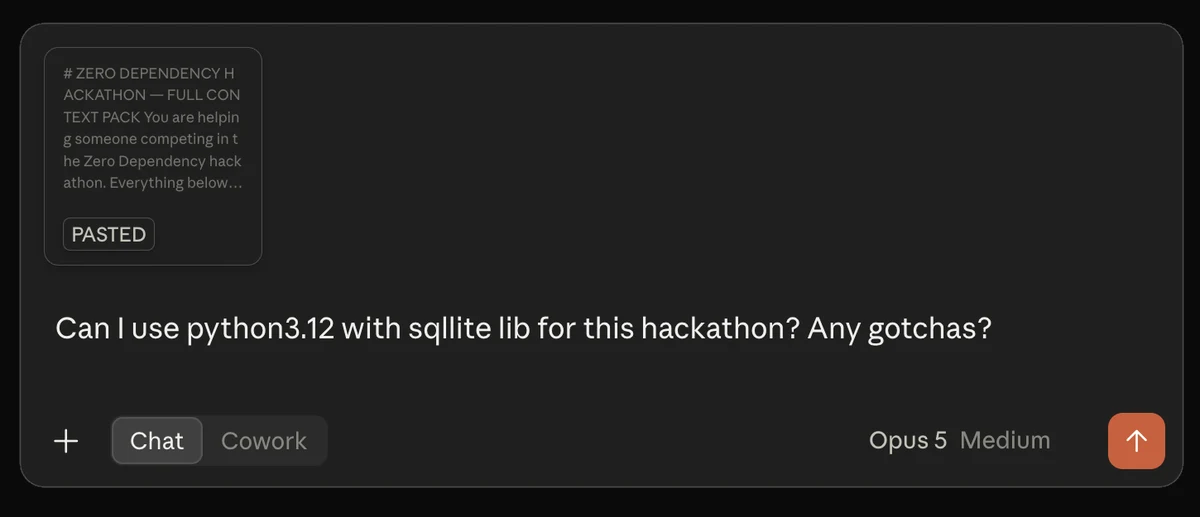
An AI assistant with the Zero Dependency context pack pasted in as an attachment, above the question: Can I use python3.12 with sqlite lib for this hackathon? Any gotchas?
Paste, then ask. That question has a real answer in the pack.
  1. 01 Copy the pack
  2. 02 Paste it above your question
  3. 03 Still wrong? ask us

Fourteen lines of hand-written JavaScript, zero packages · raw text

// read this first

Two things before you scroll

The gaps are the valuable half. Rust's std has no async runtime. Python's tomllib cannot write. SQLite is not in the .NET base class library. Read your language's "where the stdlib stops" before you commit to a track, not on day three.

Every substitution here is a STDLIB.md entry. That file feeds Zero-Dependency Craft, 30% of your score. Also: Go 1.27, Rust 1.98 and Bun 1.4 all shipped the week of 19 August, so check the versions above against whatever you remember.

// at a glance

What ships in the box

One row per thing you would normally install. Read down your column.

Need Node 24/26Python 3.14Go 1.27Rust 1.98Java 25.NET 10
CLI args util.parseArgsargparseflagstd::env::argsString[] argsargs
Tests node:testunittesttesting + synctest#[test]none in JDKNuGet
HTTP server node:httphttp.server*net/httpnonecom.sun.net.httpserverHttpListener
HTTP client fetchurllib.requestnet/httpnoneHttpClientHttpClient
JSON JSONjsonencoding/json v2nonenoneSystem.Text.Json
CSV by handcsvencoding/csvby handby handby hand
TOML Bun.TOML onlytomllib (read)nonenonenonenone
SQLite node:sqlite (RC)sqlite3nonenonenoneNuGet
Crypto / hashing node:cryptohashlib / hmaccrypto/*nonejavax.cryptoSystem.Security.Cryptography
Compression node:zlib +zstdzlib / zstdcompress/*nonejava.util.zipSystem.IO.Compression
Terminal colour util.styleTextraw ANSIraw ANSIraw ANSIraw ANSIraw ANSI
Templating template literalst-stringstext/templateformat!by handinterpolation
File watching fs.watchpollingpollingpollingWatchServiceFileSystemWatcher
Async runtime built inasynciogoroutinesnonevirtual threadsTask
UUID crypto.randomUUIDuuid v1-v8uuid (new in 1.27)by handUUIDGuid

* http.server is documented as not for production. none means the standard library has no answer and writing it is your project. Cells naming a package manager (NuGet) mean the capability exists but not with an empty manifest.

// eight runtimes

By language

What shipped recently, what replaces the package, and where it stops.

JavaScript / TypeScript

24.19 LTS · 26.x Current 24 LTS: 6 May 2025 · 26: 5 May 2026

The runtime that started this whole problem now has the deepest set of built-in replacements for it. Most of a Track A tool is already in the box.

New since you last looked

  • node:sqlite is now a Release Candidate (Stability 1.2) as of v24.15.0 and v25.7.0. No flag, no warning. An embedded database with an empty manifest.
  • Node 26 (5 May 2026) enables the Temporal date/time API by default, on V8 14.6 and Undici 8.0.
  • Node 20 reached end of life on 30 April 2026. Do not target it.
  • From October 2026 Node ships one major a year, every release becomes LTS, and the odd/even distinction disappears. Node 26 is the last release under the old model.

Where the stdlib stops

  • util.parseArgs() handles string and boolean only. Node core has stated it is deliberately minimal and not meant to replace full parsers. Subcommands, counts and type coercion are yours to write.
  • node:test has no snapshot testing or module mocking at parity with Jest.
  • No TOML, no YAML, no templating engine in the box.
  • node:sea single-executable apps are still experimental.

Instead of installing it

You'd install Use instead Since
chalk 319.8M/wk util.styleText() v20.12, stable v22.17
readable-stream 185.6M/wk node:stream + stream/promises stable
form-data 100.9M/wk global FormData + fetch v18
minimist 80.5M/wk util.parseArgs() v18.3
node-fetch / axios global fetch (Undici) stable v18
mocha / jest / tap node:test + node:assert stable v20
nodemon 7.8M/wk node --watch v18.11
dotenv process.loadEnvFile() / --env-file v20.6
strip-ansi util.stripVTControlCharacters() stable
uuid crypto.randomUUID() stable
glob fs.glob() / fs.globSync() v22
ws global WebSocket v22
better-sqlite3 node:sqlite RC v24.15 / v25.7
pkg / nexe node:sea experimental

Bun & Deno

Bun 1.4 20 August 2026 — eight days before kickoff

Bun 1.4 shipped fifteen new built-ins whose stated purpose is deleting npm dependencies. If your project is a parser, an archiver or an image tool, this is the shortest path to an empty manifest.

New since you last looked

  • Bun.TOML — TOML v1.1.0, 708/708 of toml-test, and it has a stringify(). The only runtime here with a TOML writer.
  • Bun.JSON5, Bun.JSONC, Bun.JSONL — JSON5, JSON-with-comments, and newline-delimited JSON.
  • Bun.XML — SIMD XML parser and serializer.
  • Bun.Image — decode, resize, rotate and encode JPEG, PNG, WebP, GIF and BMP, with no native addon.
  • Bun.Archive — create and extract tarballs off the main thread.
  • Bun.stringWidth(), Bun.sliceAnsi(), Bun.wrapAnsi() — terminal-column-aware, ANSI and grapheme aware.
  • URLPattern, CompressionStream / DecompressionStream (gzip, deflate, brotli, zstd), Bun.Terminal for PTYs, Bun.markdown, Bun.cron().
  • Bun.SQL — one API for MySQL, MariaDB, PostgreSQL and SQLite, plus bun:sqlite and Bun.redis.
  • Deno keeps deno fmt, lint, test, bench, doc and compile inside the one binary.

Where the stdlib stops

  • Bun's built-ins are runtime APIs, not a classical standard library. They are legal here — the rule is "Node (or Deno/Bun) built-ins only, dependencies is {}" — but write the reasoning into your STDLIB.md rather than leaving a judge to work it out.
  • Bun 1.4 is eight days old at kickoff, is the first Bun written in Rust, and closed 2,900+ issues in one release. If it misbehaves, 1.3.14 is the safe fallback. Nothing in the scoring rewards being on the newest build.
  • Deno's built-in lint and formatter have fewer rules and less configuration than ESLint and Prettier.

Instead of installing it

You'd install Use instead Since
@iarna/toml Bun.TOML Bun 1.4
json5 Bun.JSON5 Bun 1.4
jsonc-parser Bun.JSONC Bun 1.4
ndjson Bun.JSONL Bun 1.4
fast-xml-parser / xml2js Bun.XML Bun 1.4
sharp Bun.Image Bun 1.3.14
tar Bun.Archive Bun 1.4
string-width / slice-ansi / wrap-ansi Bun.stringWidth / sliceAnsi / wrapAnsi Bun 1.4
path-to-regexp URLPattern Bun 1.4
better-sqlite3 bun:sqlite stable
prettier / eslint / jest deno fmt / lint / test Deno 1.x

Python

3.14.7 3.14.0: 7 October 2025 · 3.14.7: 5 August 2026

The batteries-included language, still. The traps are narrow and specific: read-only TOML, an HTTP client nobody loves, and a server the docs tell you not to deploy.

New since you last looked

  • compression.zstd (PEP 784) — Zstandard in the standard library, also wired into tarfile, zipfile and shutil.
  • t-strings (PEP 750) — template literals for safe custom interpolation. This is the stdlib answer when you were about to reach for a template engine.
  • concurrent.interpreters (PEP 734) — isolated subinterpreters with a per-interpreter GIL.
  • Free-threaded Python is now officially supported (PEP 779), not experimental.
  • uuid gains versions 6, 7 and 8; versions 3–5 generate up to 40% faster.
  • Colour output in the argparse, json, unittest and calendar CLIs, and syntax highlighting in the REPL.
  • PEP 768 debugger interface — pdb -p PID attaches to a live process with zero overhead.

Where the stdlib stops

  • tomllib is read-only by design. There is no TOML writer in the standard library and core has repeatedly declined to add one. If you need to write TOML, writing it is your project.
  • urllib.request is HTTP/1.1 only, with no connection pooling and no HTTP/2. It is the only stdlib HTTP client you get.
  • http.server is documented as not for production. Fine for a demo; say so in your README rather than letting a judge find out.
  • No async HTTP client, no schema validation, no YAML.

Instead of installing it

You'd install Use instead Since
requests / httpx urllib.request always
click / typer argparse (with colour) colour in 3.14
pytest unittest always
toml / tomli tomllib (read only) 3.11
zstandard compression.zstd 3.14
python-dotenv os.environ + a 10-line parser always
colorama raw ANSI escapes always
jinja2 (simple cases) string.Template or t-strings t-strings in 3.14
sqlalchemy sqlite3 always
passlib (hashing) hashlib.scrypt / pbkdf2_hmac 3.6
pyotp hmac + struct + base64 (~15 lines) always

Go

1.27 19 August 2026 — nine days before kickoff

The strongest zero-dependency language in the field, and 1.27 widened the lead. If you want the constraint to feel like a normal Tuesday, pick Go.

New since you last looked

  • uuid is now in the standard library — RFC 9562, uuid.NewV4(), uuid.NewV7(), and random-component UUIDs compare with ==.
  • encoding/json/v2 and encoding/json/jsontext graduated out of GOEXPERIMENT. Classic encoding/json is now implemented on top of v2 with behaviour preserved.
  • net/http/httptest.NewTestServer — an in-memory fake network, built to pair with testing/synctest.
  • crypto/mldsa — post-quantum ML-DSA (FIPS 204), wired into crypto/x509 and crypto/tls.
  • The goroutineleak profile in runtime/pprof is generally available, with a net/http/pprof endpoint.
  • Still under-known from 1.25: testing/synctest is stable (virtualised clock bubbles for deterministic concurrency tests — use synctest.Test, Run is deprecated), plus sync.WaitGroup.Go, os.Root, and net/http CrossOriginProtection for stdlib anti-CSRF.

Where the stdlib stops

  • No YAML and no TOML in the standard library.
  • No SQLite driver. database/sql is the interface, not an implementation — Track D in Go means writing the storage engine, which is the point of the track anyway.
  • html/template is escaping-first, not a general-purpose templating language.

Instead of installing it

You'd install Use instead Since
google/uuid uuid 1.27
json-iterator encoding/json/v2 1.27
gorilla/mux, chi net/http ServeMux patterns 1.22
logrus, zap log/slog 1.21
testify testing + testing/synctest 1.25
gorilla/csrf net/http CrossOriginProtection 1.25
cobra (simple cases) flag always
gocsv encoding/csv always

Rust

1.98.0 20 August 2026 — eight days before kickoff

The hardest language in this event, by a distance. That is the point: a working stdlib-only Rust submission reads as more impressive, not less. Budget for it and be honest about what you cut.

New since you last looked

  • format_into plus core::fmt::NumBuffer — buffered integer formatting that benchmarks on par with the itoa crate. A standard-library replacement for a crate people actually install, which makes it free Package Killer material.
  • Algebraic float operations — algebraic_add, _sub, _mul, _div, _rem on f32 and f64.
  • str::substr_range, <[T]>::subslice_range, strip_circumfix, String::from_utf16le/be, NonZero::from_str_radix, Atomic::from_mut.
  • Slightly older and still under-used: File::lock / try_lock / unlock (1.89), LazyCell and LazyLock (1.80), <[T]>::as_chunks (1.88).

Where the stdlib stops

  • No async runtime. std has the Future trait and no executor. Threads plus std::sync::mpsc are your zero-dependency concurrency answer.
  • No serde. No JSON. No HTTP client or server. No TLS.
  • No rand. No regex. No date formatting beyond SystemTime and Instant.
  • std::net::TcpListener plus a hand-rolled HTTP/1.1 parser is the realistic Track C path. Plan for it on day one, not day three.

Instead of installing it

You'd install Use instead Since
itoa format_into + NumBuffer 1.98
once_cell LazyLock / LazyCell 1.80
fs2 File::lock / try_lock / unlock 1.89
crossbeam-channel (basic) std::sync::mpsc always
tokio (basic) std::thread + std::sync always
clap std::env::args + match always

Java / Kotlin

25 LTS (25.0.4) 16 September 2025 · 25.0.4 on 21 July 2026

Java 25 quietly became the best single-file language here. No build tool, no manifest, no ceremony — which lines up exactly with the Single File bonus.

New since you last looked

  • JEP 512 compact source files and instance main methods. void main() { IO.println("hi"); } in a bare .java file, with everything java.base exports auto-imported, run as java Hello.java. No build tool, no manifest, one file.
  • JEP 511 module import declarations — import module java.base;.
  • JEP 506 scoped values, a virtual-thread-friendly replacement for ThreadLocal.
  • JEP 510 Key Derivation Function API — a standard KDF interface in javax.crypto.
  • Java 26 (March 2026, non-LTS) added HTTP/3 to HttpClient via JEP 517.

Where the stdlib stops

  • No JSON in the JDK. Not one line of it. Either write a parser or pick Track B and make the parser the project.
  • No JUnit. java Test.java with assertions and a main is your test harness.
  • No SQLite, no YAML, no TOML.
  • com.sun.net.httpserver exists and works, but it is demo-grade. Say so in your README.

Instead of installing it

You'd install Use instead Since
OkHttp / Apache HttpClient java.net.http.HttpClient 11
commons-codec (hex) java.util.HexFormat 17
thread pools virtual threads 21
ThreadLocal scoped values 25
picocli (simple cases) String[] args always
commons-compress (zip/gzip) java.util.zip always

C# / .NET

10 LTS 11 November 2025 · supported to November 2028

File-based apps make C# a scripting language for the first time. The one real weakness is storage: SQLite is not in the box.

New since you last looked

  • File-based apps. dotnet run app.cs, or just dotnet app.cs, with no .csproj. A #!/usr/bin/env dotnet shebang makes it a cross-platform shell script, and dotnet project convert graduates it when it outgrows one file.
  • File-based apps default to Native AOT, so use source-generated JSON ([JsonSerializable]) rather than reflection-based serialization.
  • .slnx replaces the 2002-era .sln format; migrate with dotnet solution migrate.
  • WebSocketStream for simpler WebSocket code, and TLS 1.3 for macOS clients.
  • Post-quantum crypto: ML-DSA, Composite ML-DSA and HashML-DSA, plus AES KeyWrap with padding.
  • System.Text.Json gains strict mode and duplicate-property rejection; CompareOptions.NumericOrdering; ISOWeek for DateOnly.

Where the stdlib stops

  • SQLite is not in the BCL. Microsoft.Data.Sqlite is a NuGet package, so Track D in C# means writing a storage engine rather than wrapping one. This is the single place .NET is weaker than Node, Python and Bun.
  • xUnit and NUnit are NuGet packages. Your test harness is a main with assertions.
  • No YAML, no TOML.
  • HttpListener is the built-in server. It works; it is not Kestrel.

Instead of installing it

You'd install Use instead Since
Newtonsoft.Json System.Text.Json Core 3.0
CommandLineParser args + switch always
RestSharp HttpClient always
BouncyCastle (common cases) System.Security.Cryptography always
SharpZipLib System.IO.Compression always
Serilog (console only) ILogger / Console always

C / C++

C23 / C++23

The honest track. libc and POSIX give you sockets, files, threads and printf. Everything above that is yours to write, which is why "every line is mine" is literally true here.

Where the stdlib stops

  • No JSON, no HTTP, no TLS, no crypto, no compression, no test framework, no argument parser, no hash map.
  • pthreads for concurrency, <stdio.h> and <string.h> for the rest.
  • This is where the +5 Single File bonus is most natural, and where a 600-line program can be genuinely impressive.

// A through F

Per-track guidance

What carries each track, and the one thing that sinks a submission.

A

Developer Tools & CLI

What carries it

  • Argument parsing: util.parseArgs, argparse, flag, or a match over std::env::args.
  • File walking: fs.glob (Node 22+), pathlib / os.walk, filepath.WalkDir, std::fs::read_dir.
  • Colour without chalk: util.styleText in Node, raw ANSI escapes everywhere else. Honour NO_COLOR and check whether stdout is a TTY.

What sinks it

Shelling out to a tool you installed separately. That is a dependency you are hiding, and it is called out under Out of Scope.

Easiest in: Node or Go

B

Parsers & Data Formats

What carries it

  • Error positions: keep a byte offset and a line/column counter from the first character. Retrofitting this on day three is miserable.
  • Table-driven tests over a corpus of ugly inputs. node:test, unittest and testing all do subtests cleanly.
  • If you write TOML, target the toml-test suite. If you write JSON, target JSONTestSuite. Judges can run those.

What sinks it

A parser that only handles the happy path. Escaping, nesting and malformed input are the whole grade here.

Easiest in: Any — this is the most language-agnostic track

C

Web & Network

What carries it

  • Go and Node hand you a real server. net/http ServeMux gained method and wildcard patterns in 1.22, so you do not need a router.
  • Go 1.25 added CrossOriginProtection to net/http — stdlib anti-CSRF, no middleware package.
  • Go 1.27's httptest.NewTestServer gives you an in-memory network that pairs with testing/synctest for deterministic timeout tests.

What sinks it

Rust and C have no HTTP in the standard library at all. If you pick them here you are writing an HTTP/1.1 parser, and that needs to be day-one scope, not a day-three surprise.

Easiest in: Go

D

Data & Storage

What carries it

  • Durability is the grade. fsync after append, or say plainly in the README that you did not.
  • A log-structured store plus an in-memory index is the shape that fits in 72 hours and survives a restart.
  • Hashing for buckets: node:crypto, hashlib, hash/fnv, std::hash.

What sinks it

Wrapping node:sqlite or sqlite3 and calling it a storage engine. It is legal, but Zero-Dependency Craft rewards the layer you wrote, not the one you called.

Easiest in: Go or Rust — and this is Rust's best track

E

Security & Crypto Utilities

What carries it

  • Compose, never invent: node:crypto, hashlib / hmac / secrets, crypto/*, javax.crypto, System.Security.Cryptography.
  • TOTP is roughly fifteen lines of hmac + struct + base32. It is the cleanest zero-dep security project in the field.
  • Password hashing: scrypt and pbkdf2_hmac are in every stdlib here. Argon2 is not — say which you used and why.

What sinks it

Rolling your own cipher. It is an explicit rule, and it turns a strong submission into a disqualifying one. Rust is the trap: std has no crypto at all.

Easiest in: Python or Go

F

Open / Wildcard

What carries it

  • The README has to argue the case: what would normally be imported, and what you used instead.
  • Bun 1.4's new built-ins (Bun.Image, Bun.Archive, Bun.XML) open projects that were previously impossible with an empty manifest.
  • Java 25 compact source files and .NET 10 file-based apps make single-file wildcard projects genuinely pleasant.

What sinks it

A stunt. "Reads as idiomatic and intentional, not a stunt" is in the track's own criteria — a clever thing nobody would use scores below a plain thing people would.

Easiest in: Whatever you already know best

// +3 bonus

Package Killer targets

Pick one, replace it cleanly, document it in STDLIB.md.

The +3 Package Killer bonus wants a package people actually install, cleanly reimplemented and documented in STDLIB.md. These are already-verified targets. Bonus weight goes to the ones with real download numbers behind them.

Target Replacement Why it's worth points
chalk 319.8M weekly util.styleText() Node Already in the box — kill it by writing the colour layer yourself and beating the API.
readable-stream 185.6M weekly node:stream Node A back-pressure-correct stream implementation is a real Track B project.
minimist 80.5M weekly util.parseArgs() Node parseArgs handles strings and booleans only. Subcommands and coercion are open ground.
nodemon 7.8M weekly node --watch Node A debounced, ignore-aware watcher on fs.watch is a tidy Track A tool.
itoa crates.io staple format_into + NumBuffer Rust New in Rust 1.98 and benchmarked on par with the crate. The cleanest kill on this list.
once_cell crates.io staple LazyLock / LazyCell Rust Stable since 1.80 and still installed out of habit.
google/uuid Go staple uuid Go Moved into the standard library in Go 1.27, nine days before kickoff.
@iarna/toml Bun.TOML Bun Or write a TOML writer for Python, where the stdlib deliberately has none.
left-pad the original sin String.padStart() any Only as a footnote inside something larger. On its own it is explicitly Out of Scope.

// settled in advance

Two rulings, so nobody argues later

Bun and Deno built-ins count. Bun.Image, Bun.TOML and bun:sqlite are runtime APIs, not a classical standard library. The rule reads "Node (or Deno/Bun) built-ins only, dependencies is {}", so they are inside the line. Note the reasoning in your STDLIB.md.

node:sqlite is a Release Candidate, not an experiment. Stability 1.2 since v24.15.0 and v25.7.0: no flag, no warning, no rule broken. Pin your Node version in the README.

Anything else, ask in the Discord before the freeze. A ruling beats an appeal.

// 72 hours. one rule.

Every dependency is a stranger.
This time, invite none.

The standard library and whatever you can do with it.